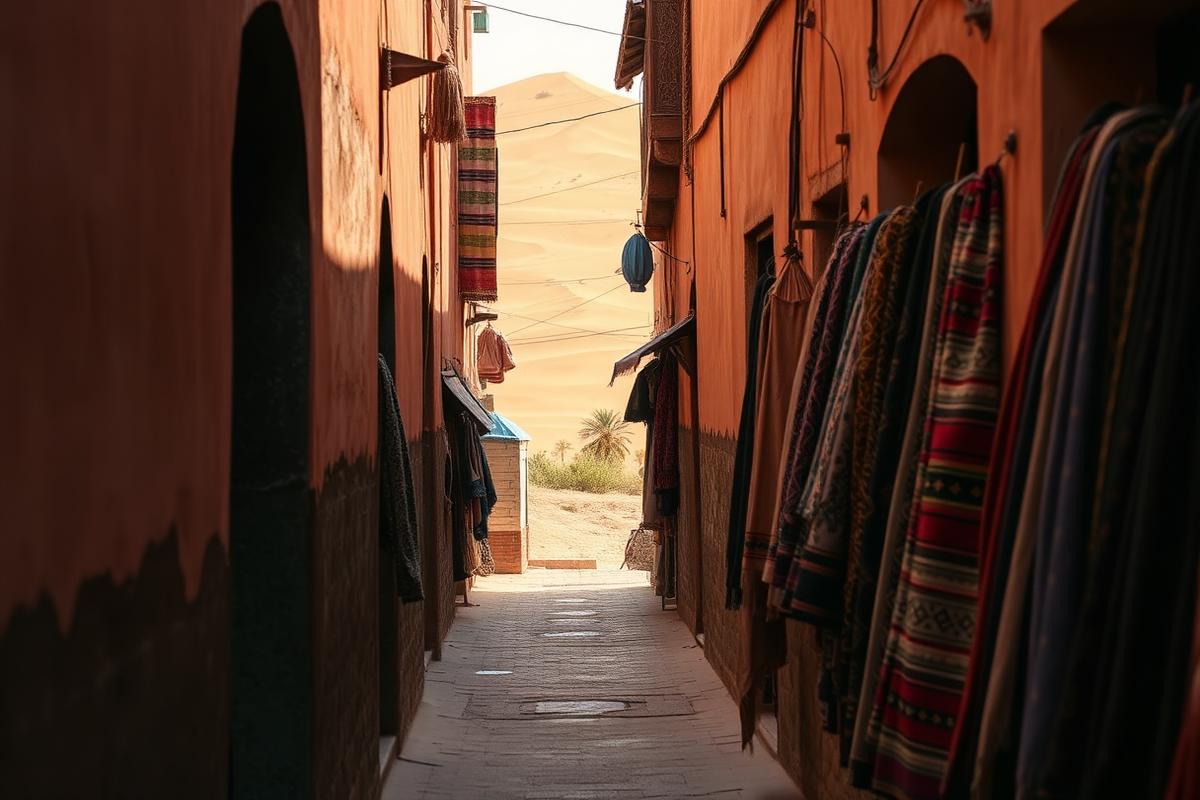

Morocco hits you immediately. The smell of cumin and charcoal and orange blossom hits you at the airport. The colors hit you the moment you step into a medina — the deep blue of Chefchaouen's walls, the dizzying honeycomb of Fès's tanneries, the warm ochre of Marrakech's Djemaa el-Fna at dusk. And then the sound: call to prayer from a dozen minarets overlapping like conversation, the tap of metalworkers, the insistent negotiation of the souks. It is an assault on every sense at once, and for a solo traveler, it is one of the most invigorating places on earth.
Let us be honest: Morocco also asks something of the solo traveler. The medinas of Fès and Marrakech are genuinely disorienting. Hustlers exist and can be persistent. Cultural norms around dress and interaction differ from what many Western travelers are accustomed to. But none of these things are reasons to travel in a group or skip the country. They are reasons to prepare thoughtfully, go in with open eyes, and approach the experience with the confidence and curiosity that solo travel builds. Morocco rewards both of those qualities handsomely.
Which Cities and in What Order
A well-constructed solo Morocco itinerary does not have to follow the tourist conveyor belt. The classic route — Marrakech, then desert, then Fès — works, but consider flipping it. Arriving in Fès first means you encounter Morocco at its most intense and historic while your energy is highest. The medina of Fès el-Bali is the world's largest car-free urban area and has been largely unchanged since the medieval period. Spending two to three nights here, getting lost with intention, is a foundation that makes everything else make more sense.
From Fès, travel south through the Middle Atlas mountains — the cedar forests around Azrou, where Barbary macaques sit in the roadside trees — to the pre-Sahara towns of Erfoud and Merzouga. From there, either loop back via the High Atlas and Marrakech, or catch a flight from Marrakech back to Casablanca for your connection home. Chefchaouen, in the Rif Mountains above Tétouan, makes a wonderful addition for those with an extra two or three days — it is small, calm by Moroccan standards, and extraordinarily photogenic.
Getting Around as a Solo Traveler
Morocco has two excellent, affordable options for solo intercity travel: the ONCF train network and CTM buses. The train connects Casablanca, Rabat, Meknès, Fès, and Marrakech reliably and comfortably. For the desert and the south, CTM operates long-distance coaches that are air-conditioned, on time, and safe. Buying tickets in advance at the station or online is recommended for busy routes; walk-up tickets are usually available but can sell out on Fridays and Sundays when domestic travel peaks.
Within cities, petit taxis are the standard option — small cars that take up to three passengers on fixed city routes. Agree on the price before you get in (or insist that the meter runs) to avoid the inflated tourist rate. Uber operates in Casablanca and Marrakech as an alternative that removes the negotiation. For the desert, joining a small-group overnight camel trek from Merzouga is easy to arrange on arrival and typically costs 250-400 dirhams per person for a night in a camp under the stars.
The Medina: Solo Navigation Without Getting Lost (Much)
The medinas are labyrinths by design — the winding, narrow streets were built to confuse invaders, and they still work. Google Maps functions surprisingly well in the major medinas with a local SIM card, but even with GPS, you will get turned around. Embrace this. The best things in a medina — the workshop where a craftsman is weaving a carpet, the tiny café up a staircase, the roof terrace with a view over ten thousand rooftops — are found by being slightly lost, not by following the optimal route.
A few practical strategies help. Identify two or three landmarks near your riad (traditional guesthouse) — a distinctive door, a fountain, a specific shop — so you can find your way back even without GPS. Do your main exploration in the morning, when the light is good and the crowds are manageable. Return to the riad for a midday break, as the heat and the sensory intensity together warrant rest. Head back out in the late afternoon and stay for the evening, when the food stalls set up and the medina becomes theatre.
Where to Stay: The Riad Experience
Staying in a riad is not just the most atmospheric option — it is also, for solo travelers, one of the safest and most socially rewarding. A riad is a traditional townhouse built around a central courtyard, typically with an open-air garden or fountain at its heart. The best riads are family-run and small — eight to fifteen rooms — with staff who will orient you to the neighborhood, arrange desert trips, and point you to restaurants that are not on TripAdvisor.
- Book a riad with a rooftop terrace — breakfast up there with a view over the medina is one of Morocco's great pleasures.
- Arrive in daylight, especially in Fès; navigating to your riad in the dark with luggage is a baptism by fire best saved for your second visit.
- Ask your riad to draw you a simple map from the nearest main gate or landmark — most are happy to do this.
- Riads at the mid-range price point (60-120 USD per night) often include breakfast, which is worth it: mint tea, msemen flatbread, honey, argan oil.
Food, Souks, and Solo Eating
Eating alone in Morocco is never awkward. The food stalls of Djemaa el-Fna in Marrakech are communal by nature — you sit on a bench next to whoever else is eating, the food is served fast and shared freely, and conversation happens across language barriers with remarkable ease. Order by pointing: the merguez sausages, the harira soup, the pastilla, the mechoui (slow-roasted lamb). A full meal at a market stall costs well under ten dollars and is frequently excellent.
The souks — the covered markets within the medina — are a shopping experience unlike anything in a mall. Each section specializes: the leather souk, the spice souk, the metalwork souk, the carpet sellers. Negotiation is standard and expected; starting at roughly forty percent of the first price quoted is a reasonable opening. But you do not have to buy anything. Walking through the souks as pure sensory experience, stopping to watch the craftspeople at work, is entirely sufficient and deeply engaging for hours.
The Desert: A Solo Traveler's Most Memorable Night
The Erg Chebbi dunes near Merzouga are Morocco's most accessible stretch of true Sahara — two hundred square kilometres of sand that turns flame-orange in the sunset light. Arriving by camel at a desert camp as the stars appear above the dunes is an experience so visually extraordinary that it functions as a kind of reset. In the desert, the perspective that gets lost in busy medinas — your actual size, the actual age of the world, what matters and what does not — comes back quietly and clearly.
Solo travelers can easily join a small-group overnight from Merzouga, which typically includes a camel trek at sunset, a communal Berber dinner around a fire, traditional music, a night in a tent under the stars, and a camel trek back at sunrise. The group element is actually an asset here: the camp's communal format means you will share the evening with people from different countries and backgrounds, and the conversations that happen around a fire in the Sahara tend to be unusually honest.
Respect, Confidence, and Cultural Navigation
Morocco is a Muslim country with strong social traditions around dress, interaction between strangers, and hospitality. Dressing modestly — covering shoulders and knees, regardless of gender — is both respectful and practically useful, as it significantly reduces unwanted attention in the medinas. When someone invites you into their shop for tea with no apparent commercial motive, it is often genuine Moroccan hospitality; when the invitation comes with pressure, a polite but firm no is always sufficient.
- A local SIM card from Maroc Telecom or Orange is cheap, fast, and solves most navigation and communication challenges.
- Learn a few phrases in Darija (Moroccan Arabic): shukran (thank you), la shukran (no thank you), b'hal b'hal (it is all the same, used to deflect pushy sellers).
- The persistent guide offers near tourist spots can be deflected with a confident "I have a guide, thank you" — you do not need to have one.
- Trust your instincts; Moroccan cities are generally very safe for tourists but standard urban common sense applies.
How to Leave Morocco
Morocco tends to be the trip people talk about for years. Not because it was easy or comfortable in the tourist-brochure sense — it is challenging, complex, and frequently unexpected — but because it is vivid in the way that only places with real depth and character can be. You will leave with mint tea-stained memories, the smell of argan oil on your hands, a carpet you almost did not buy, and a compass recalibrated in the direction of the genuinely interesting. For a solo traveler, that is precisely the point.